Did inventories become compulsory on 1 May 2026?
The changes cover how private tenancies in England work. You still make your own photo record. The Act did not give you a government form, and it did not tell you to hire a clerk.
UK Co. 17380270 · ICO ZC215268
UK Tenancy Evidence · For private renting in England
Private renting rules in England changed on 1 May 2026 under the Renters' Rights Act 2025. The government has not introduced an official standard inventory form. A dated, room-by-room photographic record on day one remains a practical way for tenants and landlords to show the condition of the home if a deposit or condition question comes up later. The government sheet linked below is the source for whether a change applies to a particular tenancy.
No account needed · Instant AI condition notes
This is for private renting in England. Scotland, Wales and Northern Ireland keep their own rules. For notice and rent, use the government sheet linked below, or Shelter.
The law, and when it started
The law is the Renters' Rights Act 2025. The changes started on 1 May 2026. From that date the government describes the end of no-fault eviction, called section 21, and a move to tenancies that no longer have a fixed end date, for the tenancies those changes cover. A notice sent before 1 May 2026 can follow different rules. Read the official information sheet for the detail.
An inventory is still your own record
An inventory is still a record you choose to make yourself. The government page covers the new tenancy rules, the written information some landlords must give, and a later landlord database. Your photo record is the file you make and send.
The deposit question did not move
When money from the deposit is discussed, schemes still compare the start of the tenancy with the end. A dated photo record from day one is what you can put next to the later photos.
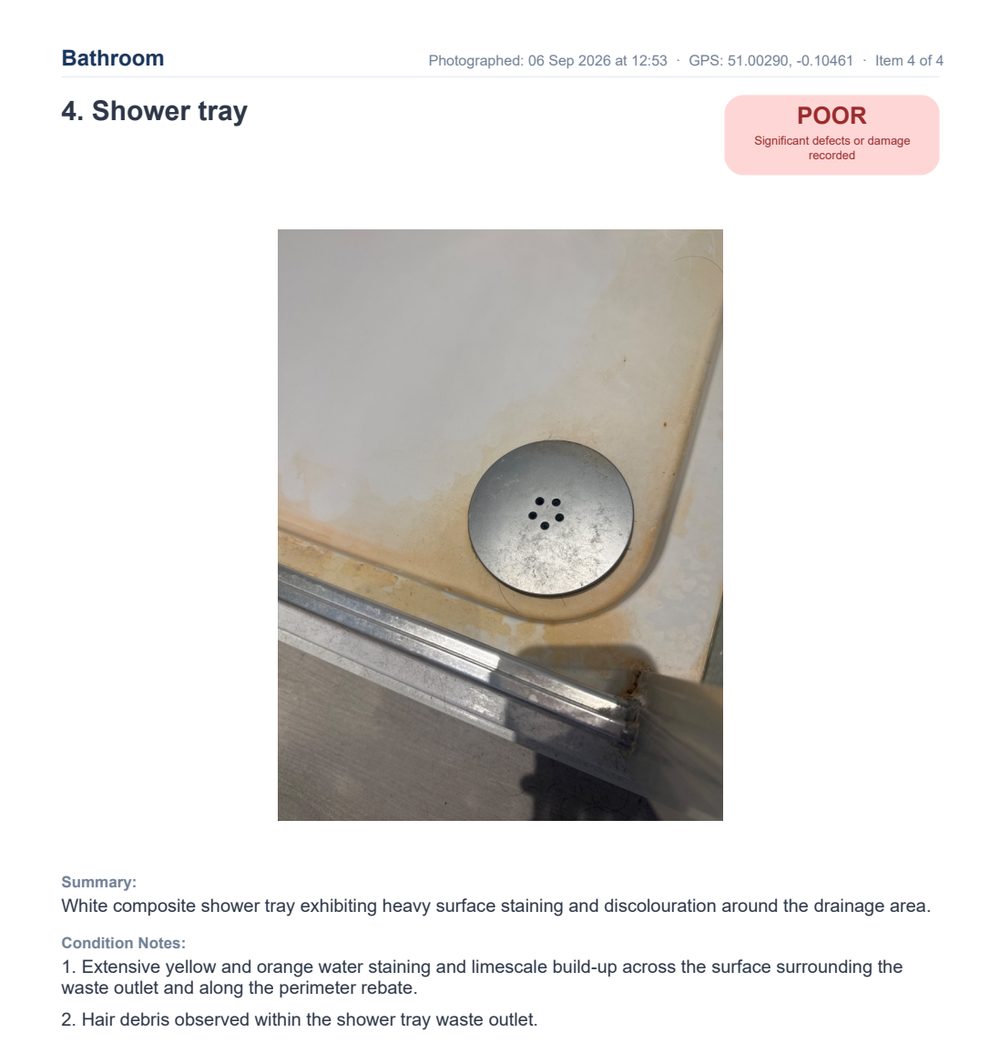
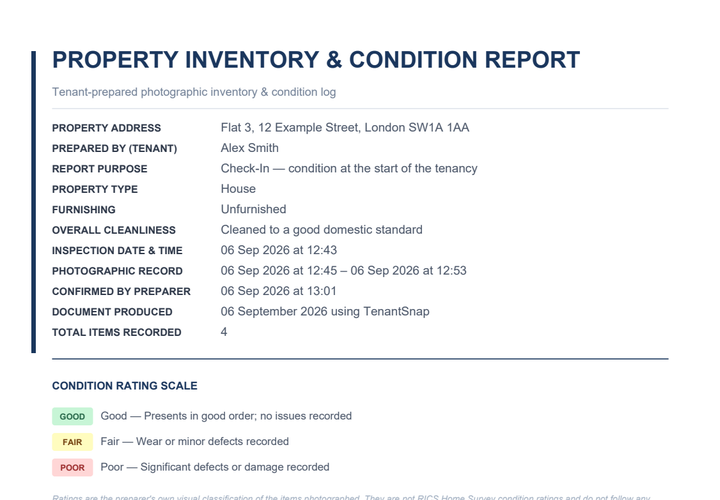
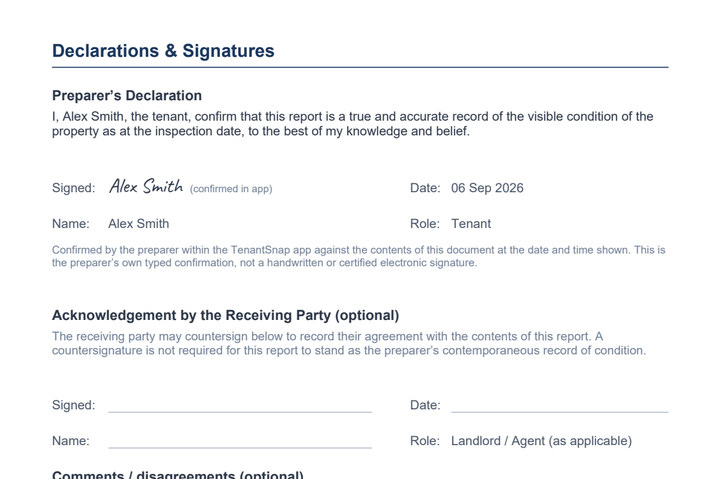
A dated, room-by-room record. These are pages from a real report made with TenantSnap.
No account needed · Instant AI condition notes
These are the changes described for private renting in England. Whether one of them applies to your tenancy is set out on the government sheet linked below, including notices already sent before 1 May 2026. Scotland, Wales and Northern Ireland keep their own rules. TenantSnap does not give legal advice.
You take the photos on your phone, check the words, and choose what to send. A deposit scheme can look at that record with the check-in and the check-out. For a survey, or for advice on your own case, speak to a qualified person. These examples follow usual practice in England.
The changes cover how private tenancies in England work. You still make your own photo record. The Act did not give you a government form, and it did not tell you to hire a clerk.
For the tenancies covered by the changes, a fixed term became a rolling tenancy. The government sheet explains who that applies to, including notices already sent before 1 May 2026. Use that sheet, or Shelter, if you need to know your own notice position.
Yes. You keep the photo record on your phone and send it yourself. To see whether the Act applies to your own tenancy, use the government sheet.
No account is needed. Up to 10 AI photo analyses appear on screen, so you can read or copy the English notes. That screen does not include the PDF or Word download. The dated, signed PDF and Word report is £9 once and includes up to 300 AI photo analyses. There is no subscription.
The free tools are listed first. The other guides follow:
Tenants & landlords
10 free scans, £9 once.